Interview by : Sébastien Jobart
Pictures by : DR
on Wednesday, October 06th 2010 - 17 015 views
He laughs when called "old-timer" but does not contradict it. Tiken Jah Fakoly, after 15 years of career and 10 albums, has mellowed. Not his message, which has not changed, but his music, which has opened up widely, forgetting horns, piano and choruses to better highlight the soukou, the balafon or the kora, with the skank taking a back seat. A new, more cross-cutting artistic direction waters down neither the sound nor the message, quite the opposite.
 Reggaefrance / African Revolution opens up a new artistic direction. How did that come about?
Tiken Jah Fakoly / After 15 years of career, it's important for an artist to surprise, otherwise you settle into monotony. I wanted to open up my music a little, to have a greater number of soldiers. We are in a fight, and this fight can't be fought without a bigger audience. I need lots of people to explain the situation in which Africans live: Africa is the richest continent; Africans, the poorest population. There's a paradox… I want lots of people to know that despite the difficulties, we haven't given up. There are people on this continent who want to make things move, a fight has to be fought. I think this wider audience can help us fight it. That's why I opened up my music, but you will have noticed that the message remains the same: a message of protest, education, political commitment… But it was important to attract a bigger audience through a different sound. I think they will join us because it's a fight for justice, for equality. There are many people on this planet who want things to be fair.
Do you think reggae was limiting your message?
Indeed. If you like, the majority of the album has remained reggae, but it's another reggae, a bit richer musically. There's a typical rock audience, reggae audience, Mandingo music audience… I need them all to carry on this fight. That explains the opening up of this album.
Today, can we say that reggae is now only an influence in your music?
I would define my music as more open. Open, but keeping its African identity. I would also define this sound as typically African reggae. The horns are no longer there because I wanted it that way, I wanted to surprise, after 15 years and 10 albums. There are no horns or piano, but there is soukous, the kora…
 J'ai grandi, je sais qu'il y a une autre manière de mener le combat... 
 In a way, there is more poetry in this new form, you sound calmer.
After 15 years, there is maturity, wisdom, which you can feel in the way of saying things. At 20, you don't say and do things the same way as when you're double that age. I've grown up, I know there's another way of fighting. That you don't have to break down the shop door to be heard. I think it's a way that can bear fruit.
As they would say in Côte d'Ivoire, you've become an old father.
(Laughs) Indeed. I want to make an intelligent revolution. I want young people to know that nobody will come and change things in our place, and that it's not by holding out our hand all the time that we'll be able to change things. As long as we hold out our hand, we'll receive something, but the politicians will give us orders with it. Or impose their way of doing things on us. I want young people to realise that this is not a good thing, that holding out your hand exempts you from going to work. You can't make a revolution with a youth that has its hand held out. When I go to Abidjan, as soon as I leave the airport, I see all these hands stretched out towards me. It's not possible. 20 or 25 years ago, you saw beggars, as you can see in France. Today, we have lots of people who have a roof over their heads, who are in good health, and who go down into the street to hold out their hand. They won't be able to bring any change.
It's a revolution of minds that you advocate.
The revolution of minds, the awakening of consciences. That the majority of our population be literate.
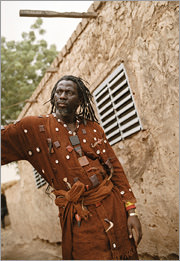 You get the impression that, unlike your previous albums, "African Revolution" is more aimed at Africans than at Europeans.
In Africa, I'm seen as an opinion leader, an awakener of consciences. I'm seizing this moment to have a face to face with them. If they trust me, let's tell each other the truth: it's true the West oppressed us, we were enslaved, colonised… But our ancestors fought against slavery and they won. Our parents fought against colonisation, and they won. What have we done? And what must we do so that our children can live in a better Africa? That's the message I want to get across. If we get moving, things will move. We have to realise that we have power, because we are the ones who put these people in power. On the eve of elections, these people who for six years think they're above us come into the ghettos and almost bow and scrape. That means we have the power. We just need to use it to command respect.
In "Je dis non", you say: "It's only a song, it won't change our lives". Are you at a point where you realise the immensity of the task you set yourself? Of disillusion?
There is no disillusion or powerlessness. My weapon is the melody, the song. I don't see myself as a politician, I have my melodies to galvanise the people, educate them and inform them. I couldn't win without them. My role is to explain to them that everything is possible, that another Africa is possible. We just need to claim power. If we don't, nobody will come and claim it in our place. We have the possibility to do it today, through the means of communication that exist. I'm not giving up, but I'm saying that the only weapon I have is the melody, the song.
Your label Fakoly Prod released the albums of Beta Simon and Jah Verity. What about new projects?
There are new projects, but today the record market has collapsed, in the West but also in Africa where piracy is very widespread. Politicians don't really take artists into account, and don't fight piracy. Producing an artist in Africa today can be dangerous because as soon as he enters the studio, the artist thinks he's financially covered. If he sees himself two or three times on TV, he'll think he's sold a lot of records and the producer can end up in a difficult situation. That's why today we're choosing artists we will really support. We don't churn them out. I wanted to produce one artist a year, but I don't want to have clashes with the artists, because they have a lot of respect for me. Fakoly Production will continue, we've slowed the pace because of the state of the record market.
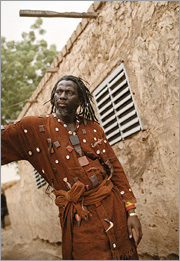 Do you consider yourself a producer?
I don't really consider myself a producer, but my role is to help the new generation, which will take over. I see it more as a helping hand that I give. But in giving a helping hand, I don't want to receive punches! We all worked on the albums of Beta Simon and Jah Verity and we didn't make any money. But we don't regret it because we allowed Jah Verity to record his album in good conditions, and to play big stages. That's our satisfaction. It's the same for Beta Simon, who had almost stopped music when we brought him into the studio; today he's playing concerts all over the place. When I started out, my wish was to find someone who could get me out of there. When I see them, I see myself at the start. Helping them is very important to me.
|
|


