

In cinemas since 13 June, "Made in Jamaica", directed by Jérôme Laperrousaz, paints a fragmented picture of a Jamaica torn between violence, poverty and musical frenzy.
Violence comes first. Omnipresent in Jamaica, it bursts in within the opening minutes: the death of dancer Gerald "Bogle" Levy, just after filming had begun, fills the screen: testimonies from police officers, TV news sequences, but above all images of his funeral, dantesque, with Voicemail and Delly Ranks getting the crowd dancing in the church. The next moment, we see Gregory Isaacs singing on the street corner, a band behind him, as a hearse with its weeping mamas slowly passes in front of them. This scene, one of the most moving in the film yet entirely reconstructed, illustrates Jérôme Laperrousaz's approach: "Made in Jamaica" is a distorting mirror, warped by the prism of his gaze. It is a documentary-fiction with actors playing their own roles.
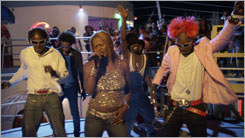
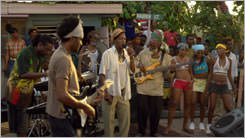
The idea: to stage the music, in the literal sense. Each appearance of the "actors" in front of the microphone is meticulously prepared and scripted. With no voice-over to comment on the images, Jérôme Laperrousaz relies on them to convey his message. Through the songs, many and subtitled, but also through the interviews. Bunny Wailer, who a moment earlier was mentioning the absence of Peter Tosh and Bob Marley, condemns this death drive, and finds its foundations: "In the past, if we had chains around our necks and ankles, we tried to break them. But today, these chains have taken the form of pistols that have been fitted to the waist of every African descended from slaves!". Vybz Kartel, for his part, drops a bomb: if Jamaica does not produce weapons, who brings them in? Who "controls the ports and the airports"? (We a kill we). Bunny Wailer drives the point home: "nobody in Jamaica has ever been convicted of importing weapons." We are getting to the heart of it, but we will go no further: Jérôme Laperrousaz has already moved on.
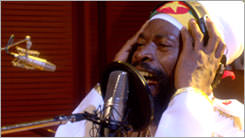
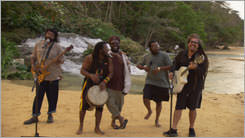
"Made in Jamaica" works like a patchwork, bringing generations and themes into collision, jumping from one subject to another. When a roaring Capleton launches into That day wil come, we cut to Third World, whom the director knows well, having devoted a film to them, "Prisonner in the street" in 1980 (as an aside, a meeting had been arranged with Marley, but things dragged on). When Kartel or Lady Saw venture into slackness (with subtitles to help), the next shot shows Stephen Cat Coore impressing on his son the importance of lyrics.
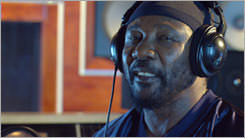
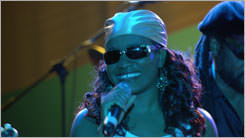
After an hour of film, the common thread grows thinner and the narrative has some dead moments. What remain are the artists who follow one another through the tableaux set up by Jérôme Lapperrousaz: Elephant Man proudly announcing that "in Jamaica, we have more recording studios per square metre than any country in the world"; Bounty Killer in the studio with his Bluetooth headset screwed to his ear; Tanya Stephens backed by Third World for a remarkable Can't Breathe; Lady Saw improvising a few rhymes in her kitchen, before rushing into her studio, two doors away; Bunny Wailer, in a sad cabaret / dancehall version of I shot the sheriff; Third World performing a superb Slavery Days in their garden at night. But also Beres Hammond, Brick & Lace, Joseph Current, Toots, Koolant…
A veritable cultural and societal mosaic, "Made in Jamaica" lays out the picture of a Jamaica drained by its slave-owning past, branded with poverty and violence, and reminds us that reggae is a popular music born in a Third World country. Its youth sing and dance to forget. "This music saves our lives", confesses Elephant Man. By confronting the generations, it illustrates the antagonisms of a revolt that eyes American hedonism and consumerism. Paradoxical and fascinating. Just like Jamaica.
The idea: to stage the music, in the literal sense. Each appearance of the "actors" in front of the microphone is meticulously prepared and scripted. With no voice-over to comment on the images, Jérôme Laperrousaz relies on them to convey his message. Through the songs, many and subtitled, but also through the interviews. Bunny Wailer, who a moment earlier was mentioning the absence of Peter Tosh and Bob Marley, condemns this death drive, and finds its foundations: "In the past, if we had chains around our necks and ankles, we tried to break them. But today, these chains have taken the form of pistols that have been fitted to the waist of every African descended from slaves!". Vybz Kartel, for his part, drops a bomb: if Jamaica does not produce weapons, who brings them in? Who "controls the ports and the airports"? (We a kill we). Bunny Wailer drives the point home: "nobody in Jamaica has ever been convicted of importing weapons." We are getting to the heart of it, but we will go no further: Jérôme Laperrousaz has already moved on.
"Made in Jamaica" works like a patchwork, bringing generations and themes into collision, jumping from one subject to another. When a roaring Capleton launches into That day wil come, we cut to Third World, whom the director knows well, having devoted a film to them, "Prisonner in the street" in 1980 (as an aside, a meeting had been arranged with Marley, but things dragged on). When Kartel or Lady Saw venture into slackness (with subtitles to help), the next shot shows Stephen Cat Coore impressing on his son the importance of lyrics.
After an hour of film, the common thread grows thinner and the narrative has some dead moments. What remain are the artists who follow one another through the tableaux set up by Jérôme Lapperrousaz: Elephant Man proudly announcing that "in Jamaica, we have more recording studios per square metre than any country in the world"; Bounty Killer in the studio with his Bluetooth headset screwed to his ear; Tanya Stephens backed by Third World for a remarkable Can't Breathe; Lady Saw improvising a few rhymes in her kitchen, before rushing into her studio, two doors away; Bunny Wailer, in a sad cabaret / dancehall version of I shot the sheriff; Third World performing a superb Slavery Days in their garden at night. But also Beres Hammond, Brick & Lace, Joseph Current, Toots, Koolant…
A veritable cultural and societal mosaic, "Made in Jamaica" lays out the picture of a Jamaica drained by its slave-owning past, branded with poverty and violence, and reminds us that reggae is a popular music born in a Third World country. Its youth sing and dance to forget. "This music saves our lives", confesses Elephant Man. By confronting the generations, it illustrates the antagonisms of a revolt that eyes American hedonism and consumerism. Paradoxical and fascinating. Just like Jamaica.
Report written by Sébastien Jobart
The screenings : Made in Jamaica, the screenings

"Made in Jamaica" is being shown in the following cinemas:
MK2 Bibliothèque in Paris (75)
Bretagne in Paris (75)
MK2 Odéon in Paris (75)
UGC Ciné Cité Les Halles
Les Cinq Caumartin in Paris (75)
MK2 Quai de Loire in Paris (75)
Le Balzac in Paris (75)
Le Melville in Rouen (76)
Cinéma Lux in Caen (14)
Majestic in Lille (59)
Kinepolis le Chateau du cinema in Lomme (59)
Devosge in Dijon (21)
Les 400 Coups in Angers (49)
Cameo Saint-Sebastien in Nancy (54)
Cinema le Rio - Clermont-Ferrand (63)
Katorza - Nantes (44)
Cinéma Comoedia in Lyon (69)
Star in Strasbourg (67)
CGR Olympia in La Rochelle (17)
Le Navire in Valence (26)
La Nef in Grenoble (38)
Megarama in Bordeaux (33)
Le Semaphore in Nîmes (30)
Diagonal-Capitole in Montpellier (34)
Comments (17)
livio · · rating: 4 out of 5
jo · · rating: 2 out of 5
rasta.us · · rating: 5 out of 5
Je m'attendais à une évolution progressive du film...il y a seulemnt un va et vient entre le dancehall et le reggae... et une petite erreur de montage lol! bref
C'est vrai qu'il y a du bon son... mais certains pionners du reggae auraient du etre présents....
De plus, comment parler de la Jamaique sans avoir une petite interview d'un membre de la famille Marley?? -par exemple-!
Il manque des images , des scènes, des témoignages etc...pour illustrer , révéler et comprendre profondément la misère des Jamaicains...
Mais ... on dira que ce film partait d'un bon sentiment...
Linko · · rating: 3 out of 5
Bounty Addict · · rating: 1 out of 5
Frédo · · rating: 5 out of 5
mistycouette · · rating: 3 out of 5
Enfin voilà, content d'avoir vu des artistes mythiques fimés façon live-clips, avec du son qui va du "frénétique" dance-hall au roots reggae. Musicalement je suis pas parmi les plus callés mais entièrement satisfaits.
Et franchement je savais pas grand chose de la Jamaïque jusqu'alors... C'est pas forcément réjouissant sur certains points cependant : armes, violence...
Et à propos de la remarque de highbud, la plupart du temps je regardais pas les sous-titres, mais quand je les regardais rien lu de contradictoire avec les paroles des artistes, les dialogues... Ou bien faut que t'apportes des exemples parce que là franchement je trouve ça n'importe quoi.
MT · · rating: 4 out of 5
troll · · rating: 1 out of 5
¤ ¤ Jah Bless Us ¤ ¤
Chrissy G · · rating: 5 out of 5
les breaks sont mal mis en place, du début a la fin, on se demande quelle est l histoire de ce film-docu.... pas de trame, sous titres parfois faux faux et re faux,
C EST SUR, les non initiés vont RIEN capter... enfin si ils vont capter des choses but not reality!
highbud · · rating: 2 out of 5
Dude · · rating: 3 out of 5
Le fim commence par la mort de BOGLE et suggére que le comanditaire est JOHN HYPE sans plus de reserve. Voilà en bref, un sentiment confus au final. Beaucoup d'artistes auraient eu des choses à dire et ne sont pas intérogés ( et parfois même pas només par les sous titres ! )
Quant à l'aspect sociologique il est à peine abordé via l'histoire de nadine cette fille du ghetto à qui J.Laperroussaz donne le micro quelques instants mais s'en détache aussi vite. Bref, un beau projet avec des vrais moyens qui au final s'avére " floper " un peu. dommage.
Pour les non iniciés, je me demande ce qui en ressort !! pas grand choses de positif à mon avis !
cb · · rating: 3 out of 5
ced · · rating: 5 out of 5
nono · · rating: 5 out of 5
la pich · · rating: 1 out of 5
paul cesar · · rating: 5 out of 5