
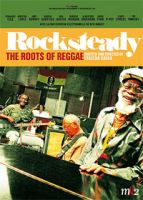
Over a backdrop of archive footage, the first notes of People rocksteady ring out, before we discover its author, Leroy Sibbles, in the studio. Around him, the Tamlins on backing vocals, Ernest Ranglin on guitar, Gladstone Anderson on piano... when suddenly, a mobile phone rings. It is 2009, and these players of rocksteady have not gathered by chance. "Rocksteady, the roots of reggae" is something of a Buena Vista Social Club in Jamaica, or what happens when the legends of rocksteady come together in the Tuff Gong studios to re-record the genre’s greatest hits and give a big concert in Kingston.
Stranger Cole acts as our guide on this journey back in time, to the sources of reggae. Sly Dunbar states it without ambiguity: "Rocksteady is the mother of reggae." You have to go back to the 60s to see it born. From calypso and mento emerges ska and its fast rhythm, a popular music, the soundtrack of the island’s independence in 1962. The rhythm slows down from 1965, and will finally turn into reggae at the dawn of the 70s. Hopeton Lewis, now a gospel singer in the USA, was one of the first artists to slow down the rhythm, on Take it easy in 1966. He has his own explanation: "I tried to record on a ska rhythm, but I couldn’t keep up, it was too fast for me".
Reunions
Brought together nearly forty years after their heyday, the legends fall into each other’s arms. "It makes me so happy to see all these musicians, some of whom I haven’t seen for 40 years. It’s wonderful", confides Ernest Ranglin, interviewed by Richie B. Indeed, the emotion is palpable. "This reunion means a lot to me and all my colleagues, explains Stranger Cole, because it’s a sort of renewal, of something gone that is coming back now. That’s what it means to me, a brand new music once again."
We thus witness some lovely reunions, like Judy Mowatt and Marcia Griffiths recalling their beginnings, or when Marcia, arriving at the studio to re-record The Tide is High, bumps into the guitarist Hux Brown, a member of Lynn Taitt’s Jets (another builder of the genre), the very man who played on Young Gifted a Black, her hit with Bob Andy recorded in 1970.
A visit to the Alpha Boys School (the famous school founded more than 100 years ago, from which the cream of the island’s musicians emerged), a rasta parenthesis with the visit of Haile Selassie in 1966, Dawn Penn and her hit No No No in 1967 (whose success she admits she still does not understand)... we thus go back up the thread of time, following the classics, plunging into an era that is now gone.
Rudies don’t fear
"That era was romantic. We sang love songs, recalls Marcia Griffiths. There was no violence, it was a time when people enjoyed themselves." But violence soon takes hold, especially in Kingston. In the late 60s, a rural exodus drove tens of thousands of people to settle in the capital, crowding into the shanty towns, slums like Trench Town, which we walk through with Rita Marley. With no work for everyone, this is the start of the phenomenon of the rudies, those gangs that scoured Kingston and who would inspire Derrick Morgan’s hit Tougher than Tough (1966).
The occasion for a lovely sequence with the prince of ska, now blind, interviewed at the Palace Theatre, the open-air theatre where he started his career "by imitating Little Richard". Skully "Zoot" Sims, also blind, calls out to him from the stage, inviting him to "jam" with him. Morgan laughs: "How do you see me?" Then, climbing onto the stage, he throws at him with a burst of laughter: "I hear you want to outdo Derrick Morgan by being blinder than me?"
Hope and diaspora
Leroy Sibbles insists on the conscious dimension of rocksteady: "We had a lot of love songs, but not only. Because we were concerned about our condition and the degree of suffering around us. We saw the distress of the poor since we were poor too, he explains after an acoustic version of Equal Rights. Stranger Cole chimes in: "The Tide is High but I'm holding on is not just a love song, it is also a reflection of our lives. It is a song of universal hope."
Like many Jamaicans, several rocksteady artists would leave the island, starting with Lynn Taitt, who went into exile in Canada, and whose absence from the documentary is regrettable (he is barely glimpsed in the bonus features on the stage of the Montreal International Jazz Festival, where the Rocksteady troupe performs in 2009. He would pass away in January 2010). Stranger Cole too left for Canada, where he became a machine operator. The last word is his: "We were poor, we came from humble backgrounds and from a small island. But that did not discourage us. We created a music that will keep on inspiring and lifting spirits."