
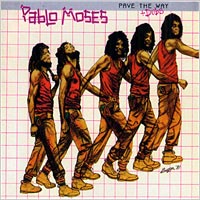
Produced by Geoffrey Chung in 1981, Pablo Moses's album "Pave the way" had never been released on CD. Yet, together with the album "Revolutionary dream", it is a masterpiece for this Rasta singer who skilfully blends mysticism and socio-political commentary. This symbol of a troubled era is at last delivered in its original version, accompanied, in a double-CD set, by the dub versions of all the tracks. The power of words and sound, as the Rasta adage goes.
Musically, this set offers a selection of the roots sound of the 1980s, represented notably by its horns (arranged here by Clive Hunt) and the use of synthesisers with new sonorities. Renowned musicians officiated at these sessions at Dynamic Sound studios. One can cite for example Mickey ‘Mao’ Chung (a guitarist who was playing for Gainsbourg at the same time), Willie Lindo (guitar), Sticky Thompson and Scully (percussion), Dean Fraser (sax) and Nambo Robinson (trombone). Despite a heavy rhythm section, the sound of this album must not be confused with the dancehall style of the Roots Radics, for two reasons: rather long tracks far from the 45 format, and instrumental breaks embellished with solos. A musical backdrop that thus sets an atmosphere one particularly appreciates on the dub versions and that lends itself to the development of conscious themes.
Words, sound and power
1980 was one of the most violent years Jamaica has known, with the elections that brought the conservative party (JLP) of Edward Seaga to power. Besides the daily violence, this period was also marked by the loss of two major Rasta artists: Jacob Miller, then Bob Marley a year later.
It is in this context that Pablo Moses offers us a vision of the world steeped in Rasta philosophy and vivid realism: praise of popular culture and of the Rasta way of life (Proverbs extractions), calls for world unity, for building and for repatriation (Pave the way, Dig on and Africa is for me). In It’s a trick, he places himself as a disillusioned observer of an oppressive society that crushes the weakest, as can be heard in Last straw. He literally depicts the Babylonian hell of Kingston, with a warning for the youngest on the magnificent Step before hell and on I see it everyday. The album ends with the no less conscious Sister, an allegory of woman as both sister of the rastaman and daughter of Africa. Poignant lyrics for a masterly performance.
This album, which does not surpass the famous "Revolutionary dream" made in 1976, is nonetheless a work of the first rank both for Pablo Moses, who delivers some very fine compositions here, and for producer Geoffrey Chung. The dub disc accompanying the original album indeed gives a glimpse of the full musical richness of this opus and the precision of the arrangements. A reissue that was long overdue.