


Originally from Suriname, it is nonetheless in French Guiana that Little Guerrier learned his trade in the band Reggae Matik, before going solo. Released before the summer, "I&I", his 4th solo album, is entirely produced by himself. For Little Guerrier is committed to his independence and his artistic convictions. That is what drives him to set up his own label, Atipa Records, with which he urges Guianese artists to do the same. Little Guerrier fully intends to hold the ground by multiplying projects with closely spaced releases. While waiting for a new album in October, Little Guerrier talks to us about his career.

"I&I" is already your 4th solo album. What has your journey been up to now?
Little Guerrier I grew up with blues and soul. A little Marley or the Skatalites, but mostly Marvin Gaye, James Brown... I came into music by chance. It really began in French Guiana. Originally, I was a dancer. I didn't live far from Pupa Abdul, who ran the station La Case. He brought in quite a few artists to voice tracks. One day I said to myself "why not?" and I took the mic, every day. They let me get on with it, and then they encouraged me to work. I made a few mixtapes, and recorded my first track with Maxi Dready. But it was with Damaniak that I really started working. After lots of mixtapes and shows at village fêtes, Nikko, who broke through with the hit Guyana Nice, brought me into the Reggae Matik project. That's how I became the lead singer.
Was it with Reggae Matik that you learned the ropes?
Little Guerrier Yes, that's where I learned everything. Together we made a maxi single, "Roots Rock Reggae", and an album, "Vibes", with which we toured all around French Guiana. At the time, there was no new reggae generation after Nikko & le Ying Yang Band, Section 2... Reggae Matik was not only a discovery but also a hope for all the young artists. We were lucky to work with professional musicians. For three years, I learned everything with Reggae Matik.
What made you go solo?
Little Guerrier Reggae Matik was a group, a collaboration; you can't be yourself 100%. I went solo so that people would discover the other side of Little Guerrier. When "Cry Out", my first solo album, came out in 2006, I was still doing shows with Reggae Matik, until 2008, when the group went on standby. Thanks to Reggae Matik, I had a calling card. I was able to promote "Cry Out" in Suriname, in Holland, in Brazil. At the time, I was recording in the studio every day. I entered the competition Neuf semaines et un jour (a music programme broadcast on RFO, ed.) with the track Black Woman (featured on the album "I&I", ed.). It's with that track that the French public discovered me.
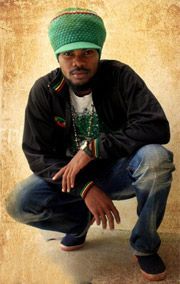
You also set up your label, Atipa Records...
Little Guerrier I created my label, Atipa Records, in St Laurent. I spent two years setting up my home studio, and I moved into artistic direction, producing other artists. Not many, because I don't want a label with 40 artists. Atipa Records houses 7 artists of all styles: rap, reggae, soul... I shared my experiences with them, but they are the ones doing it: I don't want to produce them, I want them to be able to do their own thing.
You seem to know the rules of the business well, the other side of the music scene.
Little Guerrier Even if you can't handle everything, every artist should know how it works. That's how you can defend your music better: if you know a little about the workings, then you are better armed. I have always toured, even if they weren't big stages. The important thing is to be out in the field. Today, I can even offer acoustic concerts since I started playing the guitar. On stage, the vibe is different from the studio. I don't perform the track the same way, because I don't like over-formatted shows. We offer several configurations, and so several atmospheres.
Let's talk about the album "I&I", with its very Jamaican themes and compositions. Is Jamaica your model?
Little Guerrier I was really marked by Bob Marley's Natural Mystic. I rubbed shoulders with Rasta philosophy growing up in the ghetto. At a certain age, you ask yourself questions to which only you have the answer. Natural Mystic was a trigger. I like the elders, but I was above all influenced by people from outside music: Marcus Garvey, Mumia Abu-Jamal, Cheikh Anta Diop... My family was also very militant, and it's with reggae that I was able to truly pass on that spirit. Sizzla, Buju Banton and Capleton had a freedom of spirit. Those are influences I had, but I wanted to have my own colour. I'm often compared to Jamaicans, especially when I sing in English. When I went to Brazil, people took me for a Jamaican. That is, until I speak in French or Sranan Tongo (the Surinamese creole, ed.).
By the way, you take on two Jamaican riddims on the album, the I Love riddim (Neva) and the Good love riddim (Faya De Wani).
Little Guerrier They are two riddims I loved a lot. Faya de Wani does very well in Suriname because I sing it in Sranan Tongo. It's the language the elders speak, and I wanted to show them my respect. As for the other riddims, they were made by Guianese musicians. If you listen to My Queen, you can feel the influence of the river. Our reggae really has its own colour.
How is the reggae scene doing in Suriname?
Little Guerrier It's a bit critical. That is not what pushed me to leave for French Guiana, it was personal: I lived in a small carbet, I was isolated. It scared my family, who feared something might happen to me. When I was 15 or 16, they brought me to French Guiana. It's a country I didn't like, mainly because France has a very bad reputation in Suriname. I didn't know the language; it's in French Guiana that I discovered Aimé Césaire... When you travel, you discover other cultures. \nAfter making my music in French Guiana, I went back to Suriname to present my projects, and that's where I realised how critical the situation was. The radical message is harder to accept over there. You'll hear a lot of Vybz Kartel, of slackness artists, but few artists with a conscious, radical message. A minority pulls the strings of the industry and stops things from moving forward. It's only vaguely professional, but Suriname is full of talent. When the majors get there, they're going to lose their minds. There are so many unique artists, with a unique voice timbre. I know there is a future in Suriname.
Where does your nickname come from? What are you at war against?
Little Guerrier I'm non-violent. But since I was very young, I have always been a militant in everything I do. It's love that I defend. But if you oppress me, I'll show another face, because you're touching my dignity, what allows me to live. That's the warrior side. And Little, that's because I feel I'll always be small next to artists like Peter Tosh, for example.
Do you intend to record in Jamaica?
Little Guerrier Not really. I wouldn't turn down an opportunity, but it's not a goal in itself. Prince Koloni had the chance to go there and work with Dean Fraser, and I had the opportunity to voice a track (Beautiful day, ed.). I'd like to go there one day to record. I have respect for that country... For such a small island, there are so many talents, so many role models who came out of it. Today, if I can walk down the street with my locks, it's also thanks to them...
Comments (1)
blackoss1804 · · rating: 5 out of 5