
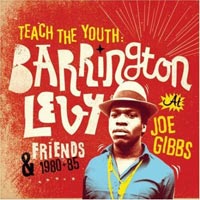
Released under VP's "vintage" 17th North Parade imprint, the compilation "Teach the youth" showcases a little-known part of Barrington Levy's work at Joe Gibbs, embellished with deejay versions and dubs taken from singles or from the label's famous "disco mixes". VP has thus dipped into the catalogue of Joe Gibbs, who died in February, to extract these few previously unreleased cuts on CD dated 1980-1985, a period under-represented in the reissues devoted to him. One of the greatest Jamaican producers of the 70s delivers a last stand here: outpaced musically by the young generation (Junjo Lawes or Jammy), he cannot compete commercially with the marketing power of a Greensleeves that dominates the dancehall market.
The dancehall style of Joe Gibbs and his resident engineer Errol Thompson (nicknamed the Mighty Two) is nonetheless not without interest: less raw and less heavy than the Roots Radics sound, it appears as a bridge between the 70s and 80s, symbolised by the use of keyboards (Give you everything) or choruses (Do good, with an airy mix in service of the voices). The backbone of the disc is made up of the eight tracks that appeared on the LP "Reggae vibes", which Barrington Levy shared with Sammy Dread, enriched with cuts by deejays of the Gibbs stable (Ranking Trevor, Lui Lepkie, Nigger Kojak and Liza) and the dub versions. The use of already well-known riddims (some had even already been used by Barrington Levy) lends itself to alternative lyrics (as on Teach the youth on the Mr Bassie or Good loving, which takes the melody and riddim of Skylarking) more than to original versions.
Another house speciality, "girls lyrics" make up the majority of the songs: My woman on the Love is not a gamble riddim (and its dub Cast eye boy) is one of Barrington Levy's hits at Gibbs, a success extended by Ten thousand woman, the version by Kojak & Liza, a male-female dancehall duo rare enough to be worth noting. The marital saga continues with Wife and sweetheart a friend (and its dub Family affair), followed by the version of the same name by Ranking Trevor, to end in tragicomedy on Quick divorce (Darker shade of black riddim, dubbed on Gwan and lef me), where Barrington begs the judge to grant his divorce. Rosemarie, the toasted version by Lui Lepkie, was one of this deejay's hits, followed closely by Late night movie on the Bobby Babylon riddim, which here serves as the backing for the track Mine yuh mouth (and its dub Mouth talk). This "Barrington Levy & friends" offers an interesting insight into this period dominated by the Channel One sound, even if it will add a little more confusion to the singer's labyrinthine discography. It is also a testimony to the final years of a reggae legend: ruined by a lawsuit over unpaid rights on a JC Lodge track, Joe Gibbs would shut up shop in 1985 and never really return to the race.