
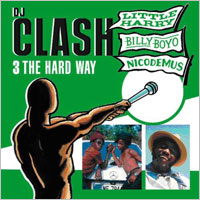
Launched for Greensleeves' 30th anniversary, the campaign to reissue the British label's classic vinyl on CD continues despite a turbulent news cycle. Case in point: this compilation, which brings together two major pieces of Jamaican dancehall from the Volcano period.
It is 1982, a year after Marley's death, and the new sound of the Jamaican dancehalls, popularised on the island from 1979 by Henry "Junjo" Lawes and the Roots Radics, is in vogue internationally. As proof, recordings of local sound system dances, which circulated in the diaspora on cassettes, are now being issued on vinyl, like the lives of Disco Aces, Gemini or Junjo's unmissable Volcano. Greensleeves is not left behind thanks to a fruitful partnership with the Volcano label and holds a serious ace up its sleeve: Yellowman, the undisputed star of the dancehalls. It must be said that the albino deejay is the label's best-selling artist and will remain so for a long time yet. Always close to the news of the Jamaican sound but also to its English audience thanks to well-marketed records, Greensleeves thus enjoys at the time a solid base from which to organise the dancehall frenzy and sign numerous artists pulled along by the Yellowman locomotive. It is in this context that two volumes titled "DJ clash" come out on the label, one red, the other green (quite a symbol, these being the colours of the two big Jamaican parties). The red one pits two deejays of Yellowman's generation, Toyan and Nicodemus, against each other, and the green one two teenagers, precocious stars, Billy Boyo (Junjo's brother-in-law) and Little Harry (who caught Yellowman's attention at a deejay contest in 1981).
"3 the hard way"
For this CD version, Greensleeves opted for a "two in one", folding Nicodemus's tracks into the content of the green volume, which thus becomes "3 the hard way". The choice may seem baffling since the recordings differ, the Roots Radics at Channel One for Nicodemus, the High times band at Joe Gibbs for the young deejays. A difference of calibre too: at 25, Nicodemus is the father figure with an already very accomplished style; the Shaolin plat featured here illustrates it perfectly. The deejay would go on to have a fine career until his death in 1996, whereas the two others would only have ephemeral fame. Finally, puberty obliging, Nicodemus drifts more readily towards slackness (very relative compared with what is done today).
One thing in common, however: the production reeks of dancehall, whether through the resolutely rub-a-dub mixes of the riddims, nice and heavy (Stop that train, Dirty Harry, Boxing, I'm not getting crazy or I can't hide to name a few), or through the vocal takes: the rhymes follow one another, sometimes jumping from one subject to another, you can feel the lyrics were worked out live and then laid down on disc regardless of stylistic imperfections (notably for Billy Boyo, the youngest of the three). One can imagine the crowds going wild at the well-judged "punch lines".
Chronicles of life
These lyrics reeled off by the mile, in a resolutely modern way for the time, are the very essence of dancehall, the reflection of a more introverted society, gnawed by violence, looking for an escape here and now. Like the original sleeve, with those two kids posing in front of a Benz, this is a far cry from formatted roots. And all the better, because with more than 20 years' hindsight, these lyrics have real documentary value: the verses are so many living tableaux of Jamaican life, often treated with humour. The attentive listener will pick up a wealth of information: places, fashionable car models, clothing or shoe brands, dishes, foods, drinks...
Dancehall itself is their favourite theme, tinged with narcissism as on the explicit Hail Nico dread, Harry on the go or Billy Boyo in the area. The more structured songs are all the more interesting: Leggo me queen by Little Harry (a pastiche of Josey Wales's Gateman) or Birdman hunting, in which Nicodemus tells the "gunmen" who practise on birds "if you don't eat the bird, don't shoot him". Though he is the least technical of the three, Billy Boyo shows by contrast real talent as a storyteller when he evokes going back to school, his timetable and rehearsing his sums (Going to school) or when he relives his trip to England (Check in): he dwells, incidentally, on Michael Fagan's intrusion into the Queen's bedroom at Buckingham Palace in June 1982, an event that caused a scandal across the Channel.
From the golden age of the formidable Greensleeves catalogue, this snapshot of dancehall well deserved a CD edition, despite the uncertainties hanging over the label's future. It is also a tribute to the people behind these recordings, most of whom have since died. Crucial.