
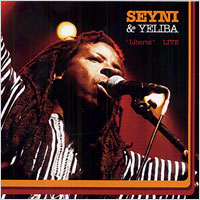
After three albums ("Allah Niki" in 1993, "Nana" in 1997 and "Limaniya" in 2002, compiled on "N'tara" in 2003), it is only logical that "Liberté" should appear today, a live recording captured in Bordeaux. Yeliba ("the great griots") is Seyni's latest band to date, after Rootsaba and Some Style Band. Despite the reshuffles, the artist's style remains the same: the balafon, a sort of large xylophone with thick wooden keys amplified by calabashes, remains the flagship instrument of his reggae. It is his brother, Nabi Kouyaté, who brilliantly wields the sticks of this ageless piano. Fans can rest assured, then: we find the Seyni we love, the Seyni of Mousso G'be and Rastaya, where flights of balafon delightfully punctuate the heavy, inspired vocal lines.
Seyni, like Tiken Jah Fakoly, presents himself as a committed messenger. However, and this is our main reservation, his lyrics are less effective. Revolt is always expressed in simple words, but Seyni does not bring to his words the humour and ferocity that one recognises in Fakoly. We much prefer him, by far, when he sings in Malinke, his native language. Rastaya is a fine illustration of this. In the flow of words one spots a word of French (bandit) and a few words of English (rasta, Jah...) but the whole remains obscure to the Western public. That is precisely the pleasure of perceiving a message in the very place where it resists us. In this sense, the best track on the album is surely La Force, where the text, which alternates verses in French and in Malinke, is irresistibly effective, something that is sorely lacking on Africa and Liberté, with their worn-out formulas.
One regrets not finding a real single. Why not have kept the superb Mon Beau Village, for example? The beauty of Seyni's hoarse, cracked singing, the Afro arpeggios of the balafon and the quality of the band make for a pleasant moment, but Seyni is typically an artist to be seen on stage.