
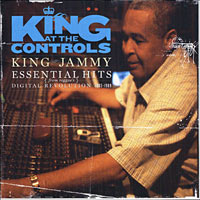
It is no exaggeration to say that Lloyd "Jammy" James and his Jammy's label were to 80s reggae what Clement Dodd and Studio One were to Jamaican music in the 60s. Still under-exploited on CD, the King's gigantic catalogue is a veritable treasure chest that still holds its mysteries. American label VP has nonetheless opted for a general-interest selection, with, as the title says, 20 essential hits, accompanied by a documentary on DVD.
Unlike the previous reissues devoted to Jammy's, notably the themed albums, hard to find, released by Next Music and Ras Records, the selection is therefore a broad one and, sadly, does not avoid a few overlaps. On the one hand, the tracklist draws both on the roots or pre-digital rub-a-dub period and on the post-1984 period of electronic reggae. On the other, the songs chosen feature established, already veteran artists as well as future stars of deejaying. Finally, the themes are happily mixed, from syrupy "lovers rock" to rasta and conscious lyrics, by way of celebrations of the dancehalls. All the tracks are nonetheless essential and deserve to be reviewed under the microscope.
Half Pint - Money man skank
Hailing from the Waterhouse district, Half Pint cut some of his finest hits at Jammy's, such as this track recorded in 1983, which lambasts the economic hardships of the ghetto's inhabitants. The High Times Band, who take on the Stormy weather riddim here, would work regularly for Jammy, the sessions with Half Pint being gathered on two magnificent albums.
John Holt - If I were a carpenter
The veteran John Holt, who had already recorded several versions of this folk-country anthem by Tim Hardin, seems particularly at ease on this digitised riddim and offers a sparkling example of Jammy's work with reggae's great voices.
Pinchers - Agony
The young singjay Pinchers scored his first hit in 1987 with this explicit track, which gave its name to this dancehall riddim in the direct line of the Sleng teng.
Admiral Bailey - Punnany
Just as explicit, the track Punnany (the Jamaican version of the American "pussy"), recorded in 1986 by the deejay Admiral Bailey, launches an original riddim that has since become a dancehall classic.
Shabba Ranks - Peenie peenie
This dancehall track by the future star of the 90s is as much the work of Jammy as of his resident engineer Bobby "Digital" Dixon. The latter would incidentally use this riddim to launch Digital B, his own label, in 1988, giving Shabba Ranks a springboard to international recognition.
Black Uhuru - I love King Selassie
An essential representative of the Waterhouse vocal style, the trio Black Uhuru (here in its second line-up with Michael Rose, Ducky Simpson and Errol Nelson) crossed paths with Jammy in 1977, resulting in a resolutely roots and rasta first album titled "Black sounds of freedom". Jammy did not yet own his own studio, however.
Nicodemus - Father jungle rock
Tied to the dancehall sound of the first half of the 80s, Nicodemus's track recorded on the No warrior riddim carves out a choice place in the deejay's repertoire.
Johnny Osbourne - Water pumping
The hit of 1983. This rub-a-dub adaptation of Hopeton Lewis's Take it easy celebrates the dance in vogue at the time. Johnny Osbourne, who met Jammy in Canada in the 70s, would be the singer who gave the King his biggest hits.
Junior Reid - Boom shack-a-lack
Performed by another future Black Uhuru singer from Waterhouse, this track is Jammy and the High Times Band's more dancehall answer to World a music by Sly & Robbie and Ini Kamoze, released the same year, in 1984.
Super Black - Deh wid you
Released in 1986 on a digital version of the Heavenless riddim, this love song by the little-known Super Black illustrates well the Jammy style, which leaves the singer all the room he needs on a resolutely modern riddim.
Cocoa Tea - Children of the ghetto
Recorded in 1984 on the Every tongue shall tell riddim played by the High Times Band, this Children of the ghetto is a magnificent pre-digital track. Cocoa Tea, who would also be a heavyweight ally of the King in the digital period, did not hesitate to turn this rather conscious track into a dubplate paying tribute to "Puppa Jammy".
Dennis Brown - The exit
In 1987, the peak of Dennis Brown's career was well behind him, but his work for Jammy, which would lead to an album, seemed to give him a second youth. Proof of it is this emblematic lover single, which once again combines the sweetness of the voice with the strength of the digital rhythm.
Nitty Gritty - Run down the world
Still in the lineage of the Sleng teng, this 1986 track by Nitty Gritty gave its name to the riddim, which seems built for him. A lover of the Waterhouse style in digital, Jammy would record very good singles for Nitty Gritty as well as for Tenor Saw or King Kong, whose styles are comparable.
Wayne Smith - Under mi sleng teng
The legendary track! Discovered in 1984 by Wayne Smith and Noel Bailey, this riddim, played for the first time on 23 February 1985 in a clash against Black Scorpio, took Jammy from the status of Prince to that of King and sent Jamaican music to another planet.
Leroy Gibbons - She's my baby
Steeped in American soul after a stay in Canada, Leroy Gibbons cut magnificent love songs for Jammy's, such as the single featured here. His work for the King, gathered on an album titled "Four season lover", symbolises for many the quintessence of the digital lover style.
Ecclecton Jarrett - Rock them one by one
An anthem to the sound system, this track on the digitised Youthman riddim offers a perfect synthesis of the Jammy style with its infectious "easy listening" side.
Leroy Smart - Let of suppum
A digital version of a track written and produced by the veteran Leroy Smart in the 70s, this Let off suppum suits Jammy's digital instrumentation particularly well.
Admiral Bailey & Chaka Demus - One scotch
A sound system professional since the 60s, Jammy knows that a good bar is as important as a good sound for making a dance work. The two star deejays of Jammy's Superpower sound know it too and cover this popular song on the Boops riddim: "one scotch, one bourbon man, one beer".
Admiral Tibet - Serious time
A digital version of the Freedom blues or MPLA riddim, this superb song by Admiral Tibet would enjoy a revival of interest a few years later, when Bobby Digital took up this recording again to add the two rivals of the day, Shabba Ranks and Ninjaman.
Frankie Paul - I know the score
The Jamaican Stevie Wonder, as he is often nicknamed, is one of the most prolific singers of the 80s, with no fewer than a hundred albums in nearly 15 years, an impressive number of them for Jammy's. This magnificent 1987 single, played by Steelie & Clevie, remains one of Frankie Paul's most emblematic.
If this tracklisting features plenty of essential tracks (some of them already very well known), the accompanying DVD is every bit as interesting. Running for around an hour, it goes back over the history of the Jammy's label, through interviews with the King himself but also with the main artists of the stable at the time: Brigadier Jerry, Josey Wales, Admiral Bailey, Chaka Demus, and Ninjaman as master of ceremonies, dispensing delicious anecdotes, not forgetting appearances by Elephant Man and Beenie Man (whom we glimpse, incidentally, at the age of nine, on stage at the King's famous dances). Besides shedding light on the context of the Waterhouse ghetto, ravaged by gang violence (two policemen tackle the subject), there are also live excerpts of the Superpower sound, notably with Ninjaman and Admiral Bailey. A very well-made DVD that complements the CD wonderfully. Enough to satisfy the purists and to encourage future reissues, which are cruelly overdue.