INTERVIEW : PRINCE FATTY
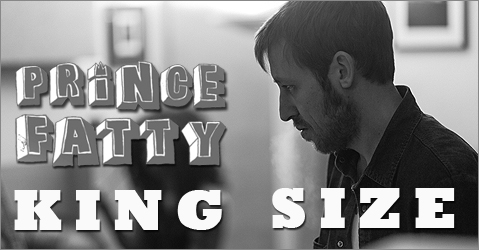
Interview by : Sébastien Jobart
Pictures by : Sébastien Jobart & DR
on Friday, April 17th 2015 - 8 619 views
The nickname refers to the sound, not the man: behind Prince Fatty, "the fatty prince", hides in fact the skinny frame of Mike Pelanconi. Still young, he is already a veteran of the music industry. You often come across the names of Lily Allen (whose first album he mixed) or Graham Coxon (Blur) when you look into Fatty's work. A bit reductive for someone who has worked since he was old enough to leave school. From the leafy neighbourhoods to the sound system nights, Prince Fatty has piled up experiences: at Acid Jazz Records, with Gilles Peterson, or for the American hip hop label Delicious Vinyl, in Los Angeles, where he worked with The Pharcyde, J Dilla and crossed paths with Snoop Dogg, who laughed at the size of his spliffs.
In Brixton, he met a whole community of artists. It was Little Roy who introduced him to Winston Francis and Dennis Alcapone, three of his favourite artists. And above all Horseman, deejay and emeritus drummer, who would never leave his side again. These two workaholics launched into a binge of projects. Does everyone want to work with Fatty? Almost! Protoje wanted his string arrangements heard on Hollie Cook's album, "Twice"; Manu Chao wanted him to produce an album for him (Fatty had remixed his track Politik Kills in 2006)... In recent months, albums by Horseman, The Skints and Nostalgia 77 have come out of his studio, not to mention the very recent "The Clone Theory", a dub album with Mad Professor and Earl 16, which will be followed by a joint tour.
Suffice it to say there is no shortage of subjects. When you start an interview with Prince Fatty, time is against you. Affable, the English producer is happy to expand on his trade and his approach to music. A gargantuan interview.
Reggaefrance / What's with this obsession with obesity?
Prince Fatty / It refers to the sound, that's how we describe it. If the sound is thick, heavy… We also use a lot of words relating to cooking: sticky, gravy… For example when I ask Horseman to play the hi-hat in a "sticky" way. Now, as for fat… I titled my first album "Survival of the Fattest". Normally it's "survival of the fittest". But in Jamaica, for example, when someone is fat, it means they have money. There's a double meaning, which also says "survival of the richest", because that's where things are heading: the poor get poorer, the rich get richer. At the time, in England, there was a lot of talk about junk food, and about how the English were going to get as fat as Americans. That was in my mind too. In general, my titles always have several explanations.
Let's go back over your career before Prince Fatty. How did you get into this line of work?
In England, you can legally leave school at 16. The day after my birthday, I left for London and started working in recording studios. I wanted to know everything about the equipment. I already knew a few things, thanks to my uncle, who worked for Decca Records in the 60s. He played guitar for Brian Eno, Marianne Faithfull, people like that. My uncle was a bit of the black sheep of the family, the one who hadn't followed the normal path. I spent a lot of time with him, he played me his rock records, the Rolling Stones, Captain Beefheart, Traffic… He had a little 4-track tape recorder, which he lent me. I'd heard about editing, but I didn't know how to do it, so I took scissors and cut the tape! I was 15. I recorded drum breaks, the one from When The Levee Breaks by Led Zepellin, or from Black Sabbath, there was a wicked drum break on their first album. I tried to edit them, but since I didn't know what I was doing, I wasted an enormous amount of tape! My uncle encouraged me to learn, to take a job in a studio. At 15, I worked all summer in a small studio in Brighton, working on adverts for the radio.

When you arrive in London, you already know the basics of the trade.
I arrive in London, at Rebel MC's studio (another stage name of the producer and singer Congo Natty, editor's note). At the time he had a lot of hits, and the Ragga Twins were there too. I turned up and told them I knew how to edit. The studio manager took a record, it was Tom Browne, "Funkin' for Jamaica". He put the record on, started recording, and began roughly dragging the needle across the record, several times. Then he handed me the tape and said: "You have 20 minutes to edit the tape and fix all the scratches." If he'd given me a Jimi Hendrix it would have been a different story, but "Funkin' For Jamaica" is very easy to edit, it's a very clean production. So I got the job and that was my way into the business. The sound system side also comes from hanging out with Rebel MC and the Ragga Twins. I worked in the studio with them, and they took me to clubs to play records. At 16, I found myself in Brixton, playing sound system at two in the morning. They're the ones who gave me my first chance, really.
 Pour le 2e album d’ Hollie Cook, je voulais faire le meilleur disque à écouter dans un jacuzzi. 
In 1995, you produced a track with Gregory Isaacs, Private Lesson.
I was working for Acid Jazz Records at the time (a label founded by Gilles Peterson and Eddie Piller in the mid-80s), when Jamiroquai and Brand New Heavies became very popular. Eddie, the boss of Acid Jazz, is a very good DJ and a great connoisseur of music. One day he said to me: "What we did with funk, going back to the roots, we should do with reggae." At the time, Dread Flimstone, a Californian reggae artist, was signed to Acid Jazz. He came to London, and we brought in Gregory Isaacs.
That's also when I met Mafia & Fluxxy and Michael "Reuben" Campbell, Aswad's producer. He would come to see me in the studio with tapes by King Tubby and Scientist… He'd open his briefcase and the tapes were just there, loose, none of them labelled… It drove me mad! I'd say to him: "Man, you can't do that, you have to respect the tapes!" I'd take them, clean them, transfer them and give him the DATs. By the way, I never charged him for that! (laughs)
I started doing my own thing. I worked with artists from Brixton, there was a reggae studio there. I met Roy Sherley there (a Jamaican singer who died in 2008, for a time a member of The Uniques, editor's note), a very special person. Through him I realised that my knowledge of reggae only went back to the 70s, the classics. But the 60s were much more obscure to me. When I met him, I thought he was just a slightly crazy old Jamaican who did lots of magic tricks. It was only with time that I became aware of the great songs to his name. He was such a simple, kind person that I didn't realise. If I'd known back then, I'd have recorded him… But I didn't have enough confidence in myself. I didn't think these guys would want to work with me. But in the end, they all said yes!
At the time, Brixton was home to a large community of reggae artists.
That's where I met Horseman, Joseph Cotton, the artists of the Brixton community. You walk down the street and you see Yellowman! One day, I ran into Leroy "Horsemouth" Wallace in the street, with a snare drum in one hand and his sticks in the other. I was stunned. I called out to him, he turned round, and all I could say was "Rockers!" I couldn't believe it. Back then in Brixton, in the 90s, you could really bump into those people. It's not quite the same now.

Horseman is a long-time accomplice, you've worked together since the beginning of Prince Fatty sound system.
We're like brothers. He's a very good drummer but he also sings very well. Although he's had hits, like Horsemove, most people only see him as "just" a drummer. He's much more than that, and seriously, I'm not exaggerating. He's a real encyclopaedia of music. If we talk about a tune, he'll ask me: "Which version? The original, the 70s one, the 80s one, Sizzla's, Luciano's?" He knows every version of every tune, which makes him very useful in the studio (laughs). He can sing harmonies much better than some singers, he can play piano, organ… He's dangerous! Like me, he's a workaholic, he likes the satisfaction of a job well done. Horseman is a very important person in my life.
What matters to you during a recording session?
Emotion and feel are the two important things. If you're working with a singer, you have to capture the emotional quality of their performance, because that's what moves you. Usually I'm not obsessed with tiny details, I try to see the big picture. I don't interrupt a take, for example, I let the momentum carry on. Which means we record a lot! I think you have to prepare the musicians, put them in the right conditions so they forget everything else and think only about the music. When we record, with Horseman, we hardly communicate, because we've been doing it together for so long. We all love the same reggae, Horseman, Bubblers and I. In general, communication is easy and quick, the opposite of usual rock sessions. Producers tend to talk too much to musicians and singers. The singer ends up with five different instructions, which only adds to their confusion.
How do you direct your singers?
I do it in small touches. And I've learned that if it doesn't work quickly, it's better to move on to something else and come back to that song later. There's no point insisting, except to make the artists lose their nerve. Sometimes it's not their fault; it's simply that what you're looking for doesn't happen. Sometimes I outright erase tapes two days after the session to start all over again. The first time I worked with The Rasites, when they came to record, they must have been tired from the previous night's gig, because the session was decent but the energy wasn't there. The next day, we started again, on the same songs. I explained to them that the day before had only been the warm-up! We recorded 10 songs that day, and half of them are on Hollie Cook's album "Twice". Those versions are splendid, but if you'd heard the ones from the day before, you wouldn't have the same opinion. There has to be alchemy, a combination of several elements: the sound, the music, the energy, everything has to be right at the same moment. Sometimes it doesn't happen. You have to be patient, and start again. I also trust Horseman: if he isn't dancing while listening to a track, then it isn't good! (laughs) The Studio One musicians did the same with Sylvan Morris, their sound engineer. If they saw him dancing in his chair behind the glass while they played, then the track was good.

You produced two albums for Hollie Cook, the first was roots, the second very heavily arranged.
Half of the songs on the first album were Prince Fatty songs. I'd started working with Hollie Cook, we'd done Milk & Honey, and I asked the musicians: "What do you think of Hollie?" Because I want their opinion, and I don't want unnecessary tension, so I always ask them if they're ready to work with this or that artist. They said "OK". I did the sums: I had 5 or 6 Hollie Cook songs. Add 5 or 6 more songs and we had an album. That's why the first album is more roots, because they're mostly Prince Fatty songs.
And for the second?
Here's the vision I had: it'll sound completely mad, but I wanted to make the best record to listen to in a jacuzzi. You're in there, with your girlfriend, relaxing… I wanted to make a sensual album but not a vulgar one, like Marvin Gaye's songs. That's why there are all these arrangements, these strings… I wanted to show it could be done. I deliberately imagined very long intros. Everything goes too fast today, doesn't it? Like "fast food"; we need "slow food". Eating over 45 minutes, taking your time, like you do in France. You can't tell a Frenchman to eat in 7 minutes! That's why I went for longer compositions, and why you don't hear Hollie for the first minute of each track. If you let the music carry you away, you're ripe by the time Hollie starts singing. You mustn't be in a hurry to listen to this album. It's like watching "The Godfather", you can't do it in an hour and a half.
Will you work on her next album?
People ask me that, but deep down I think I did the best I could, and I don't know if I can bring Hollie anything more that wouldn't be a repeat of the same thing. I talked to her about it, and I think she should explore her own world. I think it's important for artists to discover themselves, play gigs, meet different people in different places. Simply live their life. It's also time for someone else to come along and start something with Hollie to try new things. She's not just a reggae girl, she likes soul, pop, disco… That's what makes good albums. I believe there are moments that are made for people to meet.

A bit like jazz records, where you see that a single afternoon is enough to give birth to a masterpiece…
Those guys inspired me a lot, and I love the Blue Note records and the others from that era. One engineer who inspired me a great deal is Rudy van Gelder, a sound engineer who specialised in jazz, in New York. He recorded everybody and inspired me enormously. He recorded all the greats, Miles Davis and the rest, from the age of 17.
It's a job for young people: Geoff Emerick, the Beatles' sound engineer, joined them at 16…
At EMI, their opinion of pop music was very poor. If it wasn't classical music, they weren't interested. The rock bands in the 60s were all recorded by young people, because the older engineers looked askance at these long-haired guys. You see what I mean? Bob Clearmountain, the sound engineer who recorded and mixed Chic's albums, was 17 or 18 when he recorded and mixed what became huge hits. When I asked him how he got that job, he told me it was because nobody else wanted to work with those "disco guys". These anecdotes are funny.
As for me, as soon as I felt I'd done the rounds, that I'd learned everything I could learn, I left. I rarely stayed more than a year in a studio, so I've been through plenty. In the big studios, they had the best equipment, but they didn't use it! A mystery to me… I'd go and ask the technicians in charge of repairing the gear. I'd play them a record and ask, for example, which microphone had been used. And those guys could answer on the spot. It wasn't the sound engineers or the producers who taught me all that, it was the technicians. Half of the equipment in my studio was given to me by technicians. I have some very beautiful machines...
Do you favour analogue equipment?
All equipment, expensive or cheap, has a sound. In general, expensive equipment is the best, that's true. Analogue equipment in particular can behave very differently depending on how you use it. Not digital. It's like a car: the driver knows how to push the car to heat up the engine and gain a few seconds. That would be analogue. Digital would be an automatic car: you press the button, and there's not much more you can do. But I like digital too, it depends on how you like to hear music. I've made albums using only digital equipment, and nobody came to tell me it sounded worse than usual.
Let's talk about this new album with Mad Professor, "The Clone Theory". How did the project come about?
Horseman has played drums for Mad Professor, and several of my musicians also play with him, so we hear about each other very often. I went to visit him in his studio. Mad Professor has been recording for years, and he had just transferred 3,000 tracks from an analogue format to a digital one, to preserve these archives. I suggested we work together. It's like in kung fu, you have the master, the sensei, that's Mad Professor, and I'm just a little ninja. I talked to him about specific songs, like those of Yabby You, Johnny Clarke, Big Youth, the kind of dub he doesn't usually play. We did a gig together in Brighton. I had to hire the venue myself, because the promoters weren't very keen, and we played to a sold-out house! That's how "The Clone Theory" was born. Here again there's a double meaning: "cloning", the digital copying of the tapes, but also human cloning, which is really frightening. On some of my dubs (Prince Fatty and Mad Professor alternate between the album's 10 dubs, editor's note) you can hear the doctor talking about cloning.

The album is the occasion for the Dub Attack! tour.
At dub festivals, it's not "real" dub that's played, because you need a whole set of equipment for that, which is expensive to transport. That's always been my fight: having enough budget to transport all the necessary machines. And for the first time, with the Dub Attack! tour with Mad Professor, we'll be able to play the dubs from the tapes, as in the studio. Live, it's really powerful. Playing dub in its purest form is what I want. The sound system is cool, but deep, meditative dub is really my thing.
This album will be released as a limited edition… digitally!
Nobody does that! Me, I want this album to be available only during the tour with Mad Professor. When we stop touring, we'll cut the digital version too. It'll be limited, then withdrawn. I want to make music special again, so that it isn't available everywhere all the time. If you didn't buy it when it came out… tough luck! (laughs). We have to bring back that feeling of exclusivity. When I play, 90% of the music I play isn't available in record shops. People come and ask me where they can buy what they've just heard, but "ce n'est pas possible" (in French in the original, editor's note). DJs come and ask me for a mix, but I tell them there is no mix, the mix is what I just played (laughs). That's what makes the experience special. And Mad Professor, when you see him play his dubs, is really special. Once again, he's the sensei, I'm the little ninja.
Dennis Bovell is another sensei…
I'd really like to do my next dub project with him. Do you know Michael Smith? He's a radical Jamaican poet who was killed in Jamaica, probably for political reasons, because he was a trade unionist, he talked about the minimum wage, the right to healthcare, that kind of thing… He was a very special character, whom Dennis Bovell managed to capture on record. When I listened to that album ("Mi C-Yaan Believe It", released in 1982, editor's note), I was literally blown away. Dennis Bovell is a genius, not only for the music he made with Matumbi or at the Lover's Rock label. I like passionate people and rebels. And Dennis Bovell is a rebel. He had a sound system in the 70s, Jah Sufferer, long before producing records. Just like me, he learned all those years, because it takes time to understand all the possible combinations. He found an original way of making his music. Dennis Bovell's records sound as good as Jamaican records, but they have a sound of their own. And I love that. All these people we're talking about have inspired me, opened the way for me, and I'm trying to rise to their level.
|
|


 © 1999-2026


 RSS


