INTERVIEW : LONE RANGER
Interview by : Benoit Georges
Pictures by : Christian Bordey (portraits) & Lenshot.fr (live)
on Wednesday, July 04th 2012 - 9 477 views
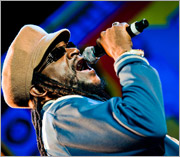
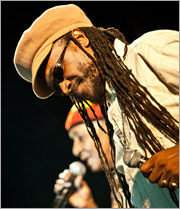
An essential deejay in Jamaica in the early 80s, with hits for Studio One and Channel One to his name, Lone Ranger is all the more so in France, where he landed in 1979, playing at the very first sound system parties in the Hexagon.
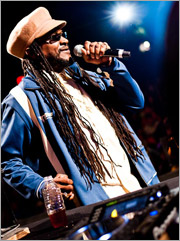
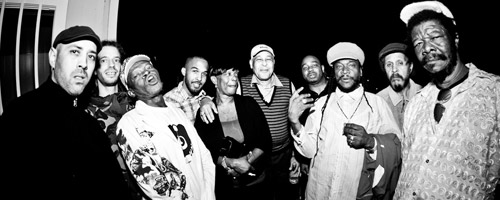
Twenty years later, he hit the road again, accompanied by the Soul Stereo sound system. The high point of this second career was his appearance on the main stage of the Garance Reggae Festival 2011 for the Studio One Revue night. We have often crossed paths with Lone Ranger over the past ten years, so it was high time to interview him. But it is impossible to talk about him without mentioning his lifelong sidekick, the producer Chester Synmoie, so inseparable were the two. Chester passed away on 10 October 2011 and we dedicate this interview to him.
 Reggaefrance / Where in Jamaica do you come from? How did you grow up?
Lone Ranger / I was born on 2 November 1958 in Kingston. In 1963, at the age of 5, I emigrated to England, where I grew up. I went back to Jamaica in 1971.
What was it like back then to be a little Jamaican in England?
When you arrive in England from Jamaica, you feel as if you've travelled into the future, everything is so different: the cold, the people...
What were your first contacts with music? Was that in England?
No, it was when I went back to Jamaica. I had a very good friend of long standing, Chester (Synmoie, editor's note), who was already immersed in the music scene. I went with him to the dances and listened closely to the deejays, my favourites being U-Roy and Jah Youth (Big Youth, editor's note). With the money I was given for lunch, I went ''downtown'' to VP/Randy's or to Joe Gibbs and bought every U-Roy or Big Youth record I could get my hands on. I went home, wrote all the lyrics down in a notebook, studied them and then sang them over the 45. That's how I got started.
 Coxsone me considérait d’abord comme son faiseur de hits. Dès qu’il voulait expérimenter des riddims, il m’appelait. 
 Did you get the chance to go to parties in England?
No, I was too young. But my mother threw parties at home. As my room was upstairs, I could hear everything going on downstairs. At the time, Jamaicans didn't have their own clubs or bars, so they recreated their little ''yard'' at home; it was the only way to have a good time.
Why did you choose the name Lone Ranger?
It happened while I was at a party in East Kingston, at a place called Rollington Town. There were two sounds playing: Soul Express, a sound from Franklin Town, which I was working with before I got called Lone Ranger. The other set was Ray Symbolic and all the deejays of the moment were there, they were tearing the dance apart. Me, I was all alone on Soul Express. When my turn came, I remembered a track by Clint Eastwood where he said: ''Eastwood is my name, I'm badder than Dillinger, tougher than Trinity.'' I used that part, saying: ''I'm badder than Dillinger, tougher than Trinity, hotter than Eastwood, my name is Lone Ranger, that's why I act like a stranger'' (''my name is the Lone Ranger, that's why I act like a stranger''). And the name stuck.
How did you begin your professional career?
Again thanks to Chester. He and his brother Leon had set up a label, Thrillseekers. We started to compose our own tunes. That's when we put out Barnabas Collins, which was a huge hit, my first hit. And it was that first hit, incidentally, that brought me to France.
 I thought Barnabas Collins had been produced by Alvin ''GG'' Ranglin
No, Alvin Ranglin only distributed it. Chester produced that tune. Everyone mixes it up and says it was produced by GG. No, he was only the distributor.
About Barnabas Collins, the song refers to a vampire character, which is rather unusual in reggae. Especially among Rastas: they chase vampires away and don't compare themselves to them. Why?
Baranabas Collins is a vampire song, that's true. I put it out because Dark Shadows was my favourite TV series. It was very popular in Jamaica and everybody rushed to watch it every evening. So I had the idea of writing about vampires and seeing if it could work. Everybody loved it.
It wasn't your first professional recording?
It's my first hit! But I had already recorded before that. Which song, I can't remember. Chester could have told you, because he's the one who took me under his wing and brought me into the studios: Treasure Isle, Thrillseekers and other small producers.
 How did you end up at Studio One?
It was Chester and his brother who took me to see Coxsone. I recorded a lot for him from 1976 on. Barnabas Collins became number one in 1979. But before that, I had recorded The answer, my very first recording at Studio One, Three miles skank, then Tribute to Bob Marley, Chase dem crazy with Welton Irie, Screw gone a north coast and finally the album ''On the over side of dub''. Coxsone saw me first and foremost as his hit-maker. Whenever he wanted to experiment with riddims or try something new, he would call me: ''Ranger, come and see me''. I would go to the studio, give him ideas and try to create something new. For example, ''Top of the class'', the last album I recorded for Studio One, during the period when I was living in New York, was an experimental album. We tried things out, a bit of this, a bit of that, even a little digital sound.
You were also a deejay for the Virgo Hi Fi sound system, which was voted sound system of the year in 1980.
Exactly, but before that, I was deejay for the Soul 2 Soul sound from Montego Bay in 1979. When I had a hit with Baranabas Collins, I was working on Soul 2 Soul. I was named deejay of the year for 1979 and I won the El Suzie Award. In 1980, I left for Virgo and the tune Love bump, which I recorded for Coxsone, was crushing everything. Once again, I was named deejay of the year and Virgo was voted sound system of the year. In 1981, we put out Rosemarie with Winston Riley: it was terrific. And the hits kept coming like that until I got involved with the Dynamite label of Clive Jarrett, where I put out Johnny make you bad so and my album, distributed by Greensleeves. People still talk to me about the Greensleeves album, but in reality it's my album. Something happened with that album that still hasn't been cleared up today. That album belongs to Clive Jarrett and me. The only album I signed away was to Channel One, the album ''M-16''.
At that time, you also had a lot of songs that clearly refer to the context of the 1980 elections: M-16, Fist to fist days done, Automatic...
Yes, that's true. And you have to know that I was a pupil at Up Park Camp, the military base. I grew up with all that, on the front line. On that subject, I know more than most.
Why did you leave for New York when you were so popular?
I left for New York for a tour, which began on exactly 18 September 1981 at Madison Square Garden. I was very popular and in great demand. There were several of us: Louie Lepkie, Sammy Dread, Carlton Livingston, Tony Tuff and Tristan Palma. We did a big tour of North America and Canada. I then lived for 16 and a half years in New York. I immigrated legally. And in the meantime, a good part of my family had gone over there: my mother got citizenship, my brother too... I had a visa and went back and forth to Jamaica. And then one of my children, my son, was born in New York, so I told myself I'd stay there a little while to work. It gave me opportunities: in Japan, in Guyana, in Bermuda... It was my little regular circuit, in a way.
How did you find life in New York?
For me, life in New York was good. I don't know what it might have been like before, or for other Jamaicans, but I enjoyed that period. I love New York. And besides, there were a lot of parties, clubbing...
In France, we've known you for a long time, because you were one of the first deejays to come and see us, back in the 1970s.
Yes, I first came to France in 1979, thanks to the journalist Hélène Lee. She made it all possible. It actually happened one night when the Virgo sound was playing at 82 Chisholm Avenue, Sugar Minott's hangout. I had loads of hits at that time, so when I took the mic the crowd was hot, shouting, jumping, banging on the barriers until they fell down. All night long, guys spent their time putting the barriers back up and with every tune, boom, down they came again! Hélène Lee was there, she saw it and at the end of the night she came up to me: ''Lone Ranger, I saw you on the mic, if I bring you over to France, do you think you can do that again?'' I answered: ''of course!'' She told me: ''I'll get back to you''. Four to six weeks later, she was back in Jamaica to organise my trip. It was the first time I'd returned to Europe since leaving England, and the first time I'd set foot in France. At the same time, Island Records had released Barnabas Collins on the WEA and Phonogram labels. So my tunes were being played in France, even though we had never signed any contracts!
What did you notice in France regarding the reggae scene?
I saw that it was developing well. Even back then, there were quite a few clubs where you could hear reggae. There were also venues, like the Chapelle des Lombards, the Pompidou Centre...
But there were no real sound systems at that time?
That was a bit our mission. We had brought a lot of records with Chester and sometimes we took care of the sound system: Chester played the records and I was on the mic. A first for France! You couldn't easily find Jamaican records in France, which is why we had brought our own. We were on the move with them all the time and it was still a hassle, because vinyl is heavy and can easily get damaged.
As a deejay, your style stands out strongly, particularly compared with that of the older generation. How was it so different?
First, I wrote stories: I'm a deejay who tells stories, from beginning to end. I also had original gimmicks, little quirks of pronunciation, as if I was mumbling on the mic, and I was more melodic. And then, I tried to chat for as long as possible without stopping.
Why did you leave New York?
Jamaica called me. In 1998, the number of deejays had exploded, but I couldn't really see which direction the music was going in. To me, it was leading nowhere. I couldn't hear any rub-a-dub at all. When I came back to Jamaica, everyone told me: ''Ranger, everything's different now, people don't listen to your stuff any more, because of this new dancehall''. I told them: ''that's fine, now I'm back, I'm a king among deejays and I'm going to bring my rub-a-dub back to Kingston.'' And that's also when I started working with Fata, of Soul Stereo, around 2000. When I came back to Jamaica, I spent a year doing nothing: no recordings, no shows, nothing, I just listened to what was on the radio, other artists' tunes. The year after, I started hanging around the studios again, but I still had no work for producers, no shows... I was just there to feel the vibes of the moment. And then I met Fata (of Soul Stereo, editor's note), at Techniques. I was with Winston Riley, we were listening to tapes and he walked in. I cut a dub for him and told him to go back to Paris, play that dub and see if there could be shows for me over there. Fata didn't believe me at first, but he didn't waste any time and soon after, we left for Paris.
It's a beautiful story, this meeting with Soul Stereo. You started with small dates, up to the Studio One Revue at the Garance Reggae Festival last year...
I felt good when I went on stage at the festival because I knew that many of my fans, from all over France, were going to watch me work properly on that big stage: they were finally going to see what Lone Ranger is really capable of.
|
|


 © 1999-2026


 RSS


