INTERVIEW : LEE JAFFE
Interview by : Sébastien Jobart
Pictures by : Lee Jaffe
on Wednesday, September 11th 2013 - 13 655 views
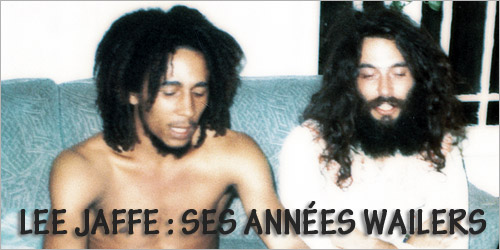
An American artist, Lee Jaffe hung out with the Wailers for three years, between 1973 and 1976. This painter, photographer, harmonica player and visual artist met Bob Marley by chance in a New York hotel room. It was the starting point of a long day-to-day adventure with the Wailers, whom he followed to Kingston.
At Hope Road, where he lived, Lee Jaffe witnessed the birth of several songs, also lent a hand in writing Talking Blues, Roadblock and I Shot The Sherif, and even went on stage with them. Later, he would produce Barrington Levy, Joe Higgs, the Wailing Souls and Morgan Heritage.
From his three years alongside the Wailers, Lee Jaffe kept a host of anecdotes that he recounts in "Bob Marley & The Wailers, 1973-1976", a book co-written with Jérémie Kroubo Dagnini (author notably of" Vibrations Jamaïcaines", "Les Origines du reggae: retour aux sources"). The many photos (we reproduce a few of them) enrich these memories that Lee Jaffe had already shared with Roger Steffens, for the book "One Love: Life with Bob Marley & The Wailers", which inspired "Bob Marley & The Wailers, 1973-1976".
Lee Jaffe continues his work as an artist, which is bringing him to France: as part of the 12th Contemporary Art Biennale in Lyon, an exhibition is devoted to him (paintings, sculptures, videos, photographs…). We met him while he was passing through Paris. An interview with the man nicknamed the "White Wailer".
Reggaefrance / You were a privileged witness to Bob's international breakthrough. What struck you about him when you met him?
Lee Jaffe /  When we met in his hotel room in New York, I was friends with Jim Capaldi, the drummer of the band Traffic (signed to Island Records). I had gone to England a few weeks earlier, I was preparing a film that we were due to shoot in Chile. There was this Jamaican actress, Ester Anderson, who had just appeared in a film with Sydney Poitier ("A Warm December", 1973), and I was there to get her to sign. She told me to come and join her at her place and that we'd go to the premiere of the film "The Harder They Come", by Perry Henzell. The director and the producer of the film came to pick us up in a car, and the producer was none other than Chris Blackwell, the boss of Island Records. The screening was in Brixton, and I was the only non-Jamaican in the room. I knew nothing about Jamaican culture at the time. Harry Belafonte, that's about it. The film is spectacular, and it was a real culture shock. Meanwhile, the situation in Chile was deteriorating, the CIA was getting rid of Salvador Allende. Thousands of people were disappearing, including our co-producer. There was no question of my going there any more. Back in New York, Traffic had just played Madison Square Garden, and I found myself in that hotel room with this Jamaican sitting in a corner.
Jim told me I should listen to his songs that he had brought with him. The first song was Concrete Jungle, then Slave Driver, 400 Years… It was the most incredible thing I had ever heard! Bob was in New York to buy equipment. Catch A Fire hadn't come out yet at the time. We spent time together, I took him to buy instruments. I also had a friend who had the best herb in New York. I'd take the harmonica, he'd take the guitar, and we'd get going. Chris Blackwell had chartered a plane to go from Kingston to the Trinidad carnival. Jim Capaldi and Ester Anderson were going, and I was invited too, since I was hanging out with Bob. I didn't know what to do with my life any more, and this trip promised to be memorable. I went, and when we got back to Kingston, I stayed at Hope Road. It was an old colonial house, with the old slave quarters at the back, which Chris Blackwell had turned into a rehearsal studio. Chris wanted to release more Jamaican music. After "The Harder They Come", he was going to re-sign Jimmy Cliff, who left to join EMI Records. It was a big shock for him. When the Wailers were left stranded in England, with no money to get home after parting ways with their manager (Danny Sims, Ed.), Chris signed them on the spot. He recently confided in me that Island Records wasn't ready at the time to have two artists in development. So if Jimmy Cliff hadn't left, Bob Marley and the Wailers would never have signed to Island Records!
At Hope Road, you shared the Wailers' daily life. You found yourself playing harmonica, you witnessed the writing and composing of many songs…
 Yes, I had a room there. When I listened to the album for the first time, I knew it was the best I had ever heard. Full stop. It was fantastic on so many levels: the poetry, the newness of this music, the musicality, and of course the spiritual, political and social dimension of the lyrics. When I arrived in Kingston and met the other members of the band, I knew there was nowhere in the world more exciting, at that moment. I didn't want to leave, I wanted to help get this music out, to make it known. And I was lucky enough to be able to do so. I spent many nights sleeping on the porch of Stephen Marley's mother's house. They were building a house at the time, there was no bedroom. One morning when I was still asleep, Bob settled down next to me and started playing Talking Blues: "Cold ground was my bed last night / And rock was my pillow too" ("the cold ground was my bed last night, and stone my pillow"). That song is about me sleeping on the ground!
You even grew your locks…
Discovering Rastafari and its culture really changed my life. I would already be dead without it. At the time, I wanted to live as intensely as possible. I didn't want to go past 30, I wanted to cram as many experiences as possible into the shortest period of time. Rasta philosophy is totally the opposite: you live for ever, and you must take care of your body, which is a temple. It has affected every moment of my life since.
 Découvrir Rastafari et sa culture a vraiment changé ma vie. Je serais déjà mort sans cela 
The album "Natty Dread" is an important moment, you argued with Bob for several reasons: you aren't credited, you like neither the title nor the cover…
In Jamaica, the song came out under the name Knotty Dread, it was about dreadlocks. But when we saw the album cover, the title had been changed to Natty Dread, which to me meant the opposite of what the album was about. We argued a lot about it. I didn't much like the drawing either, it didn't reflect who Bob was. Being an artist myself, I was very disappointed. I wasn't credited on the album, but that wasn't the most important thing. But changing the title was too much. I had to take a stand… It was too late, because everything was printed, but I didn't want to let him do that. We argued a lot, and we didn't speak to each other for months afterwards. When I got arrested downtown, it was Rita who brought me food behind bars. Then Bob sent money to get me out of prison.
In prison, you came across Bucky Marshall, a famous gunman whom you knew well since he was close to the Wailers. You also hung out with Claudie Massop, Tek Life… These men were really dangerous, were you aware of that at the time?
When I was living at Hope Road, Tek Life and Frawser lived there too. They went everywhere with me if Bob wasn't around, at his request. They were teenagers, really very young. I never took it seriously at the time; I didn't feel in danger. I knew West Kingston was a dangerous place, that people shot at each other and died. I knew about political violence, because our music was political too. But I told myself we were artists, musicians, and that we wouldn't get caught up in that violence. Of course, I was wrong. I was naive. When I got up in the morning, Frawser and Tek Life would recall their adventures of the night before. Back then, I never really believed those stories... They all died very young. We thought we were immune to that violence. We moved in it, we talked about it, but I never thought it could actually reach one of us.
 Lee Jaffe and Peter Tosh © Lee Jaffe
You witnessed the split of the Wailers. It wasn't a brutal break, more a mutual consent.
Bunny didn't want to tour: there was a break anyway. What's the point of making an album with someone who doesn't want to tour? You might as well take someone else. That's what had happened on the tour for the album "Burning" in 1973. It was my idea to bring in Joe Higgs to replace Bunny Wailer. On top of that, the first two albums weren't selling, they weren't making any money. Peter Tosh, for his part, had enough songs to fill two albums. Peter made his voice heard. He really wanted to record those songs; it wasn't just a disagreement with Bob.
You co-produced Peter Tosh's first solo album, "Legalize It". Bob even lent him money to record the first tracks at Treasure Isle...
People talk about competition, but it wasn't like that at all. In fact, Chris Blackwell helped us get that deal with Columbia. When we were near the end of the album, I started going round the labels that might be interested. There were several, including Atlantic Records, which I think would have been good. Peter was still tied to Island Records through the Wailers' contract, so he had to be released from it. Chris Blackwell wanted Peter to sign with a major.
 Peter Tosh © Lee Jaffe
To finance the album "Legalize It", you set up an international ganja deal... That sounds insane, doesn't it?
Yes, but it was crazy to live where I lived! It was dangerous, of course.
You write in the book that Peter wanted to get on the plane with you, but you refused.
What if we had been arrested? I would have been responsible for Peter Tosh's arrest... I wasn't prepared to accept that responsibility. It would have been my legacy, what I'd be remembered for for the rest of my life...
There's also the story of the photos in the cannabis field, which Columbia initially refused.
 Columbia Records didn't want the photos of Peter in the field of weed, any more than they wanted to call the album "Legalize It". At the time, nobody in the United States knew what a marijuana field looked like. Bob had taken me to see that field at my request, and it was stunning! I'd been smoking for years, but I had never seen the plant in its natural state, up in the mountains. I knew that having that on a sleeve would get people talking. I had sent seven shots from that session in the field, but Columbia claimed to have lost them... We insisted, so I sent them an eighth photo, which is the one that finally appears on the sleeve!
When did you last see Bob?
The last time I saw Bob, I drove him to the airport so he could go to Germany because he was ill. I was with him every day in New York while he was in hospital receiving treatment. I was with Roberta Flack, who was a friend of Bob Marley's. It was a sad day. While he was in Germany, I called him once a week.
You also produced Joe Higgs, who was introduced to you by Bob Marley, whose mentor he was. He too lived at Hope Road.
I found Joe Higgs again in 1986 when I moved from New York to Los Angeles, where he lived. We started seeing each other every day, and I took him to a friend's studio to record. We made two albums together, not the best ones, sadly. The best is the one produced by Earl Chinna Smith, "Triumph", a real masterpiece, a classic of Jamaican music. The two albums I produced are good, but the one made by Chinna is truly fantastic. We made other recordings with Joe, in Ireland, with local musicians, Hothouse Flowers. It never came out; I hope it will one day. It's a fantastic experience, a crossover of reggae and Irish music. The label went bankrupt before the album's release. Some tapes were lost, but there must be 7 or 8 tracks that we should put out. I also co-wrote the song Life of contradiction on one of his first albums.
How did you end up producing Morgan Heritage's first album?
MCA Records offered me the chance to produce Jamaican music for them. I accepted, and my first idea was to make a live album at Reggae Sunsplash. I brought in a state-of-the-art mobile recording truck from Miami and set about the pre-production for recording those four days of music. A few days before, I met Denroy Morgan, whom I hadn't seen for a very long time. He was happy that his children were playing at the festival, not on the main stage, but at a beach party the night before. I went to see them, and they were incredible; they took my breath away. I asked the festival promoters to have them play the opening slot on the first night. At Sunsplash, the shows go on until dawn and there aren't many people early in the evening, so they agreed. Morgan Heritage got to perform on the main stage, with good sound. It was a showcase. The MCA executives signed them on the spot, literally as they came off stage. We recorded the album in Brooklyn. Denroy had this big house in Bushwick, in the ghetto. He had a garage in which he had built a recording studio. We recorded the album "Miracle" over one summer.
You met up with the Marley family again during Familyman's lawsuit against Rita Marley, in which he claimed royalties... You were on Rita's side...
It was so sad, the saddest thing... I was on the side of the truth. Familyman wrote neither the lyrics nor the melodies. In the eyes of the law, the melody and the lyrics are the two halves of a song. He wrote neither. I hadn't seen him for a long time. And I don't think I've seen him since... But I think Familyman was an essential contributor to the music. The musicians had made a deal with the Marley family, an arrangement I don't know about. The saddest thing is that Familyman should be working with Bob's children. He is still an excellent musician. I don't know why he didn't go in that direction. If he had spoken to me about the production of the album, I would have given him very different views on his contribution. Because he was much more than just a studio bass player. He worked on the arrangements, on the production. He was there very often, far more than a musician. His complaint should have been about his input to the production of the albums, not about the writing of the songs... Together with Familyman, we produced an album, "Talking Blues". Bob Marley did nothing but sing. I set up that session (at radio station KSAN in San Francisco, Ed.), and Bob left everything to us. I was a bit like Familyman's assistant in the studio, and he did everything! I don't know why Familyman didn't take action over that; I could have done something. What's sad is that he spent all that money on lawyers, to find a legal way out for an unfounded grievance, doomed to fail. He could easily have reached an arrangement with the Marley family and carried on working with them. Because the children adore him! It's a continuing sadness... Familyman was badly advised. He should have known, even with his battalion of lawyers, that he was going to lose.
 Bob Marley & The Wailers, 1973-1976
By Lee Jaffe & Jérémie Kroubo Dagnini
Publisher: Camion Blanc
298 pages
Price: €30
|
|


 © 1999-2026


 RSS


