INTERVIEW : STAND HIGH PATROL
Interview by : Sébastien Jobart
Pictures by : DR
on Friday, February 13th 2015 - 8 711 views
The three musketeers of dub have struck again. With their new album, "A Matter of Scale", the members of Stand High Patrol have made an album in their own image. Introduced by the singular single Sleep On It, "A Matter of Scale" opens up to jazz sounds. "This album is made to be listened to at home, which is also what sets it apart from the first one", adds Pupajim.
Billed at Nova's Nuits Zébrées, the patrol joins us backstage, accompanied by Meriadeg Guillanton, who plays the trumpet solos on the album. A chance to go back over the genesis of "A Matter of Scale".
Reggaefrance / What does the title of the album, “A Matter of Scale”, refer to?
Stand High Patrol / Pupajim: It took us a while to find this title. You only see one piece, but we wanted it to be an album that works as a whole, that can be listened to from A to Z, with a story. It's this idea of taking a step back, of having an open mind. Listening to other styles of music: reggae comes from somewhere, from blues, from jazz, and those musics also come from other things.
Macgyver: There's the idea of putting things into perspective.
Pupajim: There's also the idea of time scale. Music is built on cycles. You don't create out of nowhere, you always draw inspiration from something to go further. And finally, “scale” also refers to the musical scale. There are several meanings, which we leave to each person's interpretation.
That open-mindedness is evident from the very first track, which introduces this jazzy sound.
Pupajim: I listened to a lot of jazz while composing the album. Alongside that, when we play sound system with Roots Atao, Goldie (their selecta, ed.) plays a lot of rocksteady, and that influenced things too. Originally, we wanted to make some rocksteady-style tracks. I put in this jazz drumming to get a special groove, so that the skank wasn't locked onto the beats every time. And it worked well!
Meriadeg, how did you end up playing trumpet on Tempest and Geography?
Meriadeg: It was Théo (Macgyver, ed.) who introduced me to the band. He played me what they were working on. They used a lot of samples in their compositions, more than before, which brings a grain. For me, in their way of composing, other aesthetics, other colours had arrived. We did some trials, for the album and for the live show.
 L’idée, c’est de plonger les gens dans notre univers, à la fois sonore et graphique. 
How did the track Geography come about?
Pupajim: The word “Geography” alone appealed to me for the chorus, I thought it sounded good. It was going round in my head a bit, I had this melody… The verses also relate to this notion of open-mindedness, of observation, of being curious, really. It can be transposed to anything: music, cooking… Musically, I wanted something “pure”. I wanted to recapture the sound of an Augustus Pablo production that I heard played by Aba Shanti-I in London, in 2004. On that dub, there are only two bass notes, now and then, with everything floating around them. I wanted to find that again.
What strikes you on these tracks is the space…
Pupajim: Yes, and that leaves room for Meriadeg. Leaving silences, letting the music breathe, is important. Geography is my favourite track. On first listen, it can throw you a bit, because there isn't much there, it hangs by threads… It's a bit like an Iration Steppas session in England: the track starts with the intro then everything stops, except the cymbal which stays, before it all takes off. That moment with only the cymbal, those few seconds, time stops…
Was it to make a statement that Sleep on it, in the same vein, is the album's first single?
Pupajim: The video work was important on this track. We gave the album to Kazi and Charlie (Kazy Usclef and Charlie Mars, the directors of the clip, ed.) and this is the track they wanted to put into images. It's the first time we had something graphic and animated, and we wanted to push that forward straight away. In fact, they're the ones who chose the single (laughs). But I think we would have chosen one of those jazz tracks.
In the lyrics of Sleep On It, there is still a melancholy, a form of sadness.
Pupajim: Sadness but also hope! That's what moves me in music, especially in rocksteady.

Do you know how you're going to play these tracks on stage?
Pupajim: It's difficult... On stage, we can play one or two, but in sound system it's harder. Vocally, I almost have to shout in a sound, and I wouldn't be able to do Geography, for example. But when we play it on stage, when Meriadeg is with us, it works well. This album is made to be listened to at home, which is also what sets it apart from the first one.
Anyway, you never play the tracks identically live…
Pupajim: Some tracks with different mixes… But it's true that we've never really worked that way.
Rootystep: We're playing loads of tracks at the moment that we might release afterwards.
Like No Matter How Long It Takes, which you've been playing for a while… On that track, Jim, your singing is a bit different.
Pupajim: Yes, I was trying things out... In fact, I'm always learning to sing (laughs). I wanted to try new things, go down a bit lower into the low register. And I won't hide it, Michael Prophet inspired me a lot on that one.
Ruckus and Blue Wax represent the hip-hop side.
Pupajim: I really think that if we'd started the album six months later, there would have been even more hip-hop, because we went back to hip-hop a lot, to please ourselves. As it is, it's good with the two tracks. There were lots of tests, but if these tracks work well live, they worked less well on the album.
And naturally we end on the fundamentals, the English school, at higher tempos…
Pupajim: That's right, but I'm not sure the tempos are higher… I even think it's slower than the rest of the album, but it can feel multiplied. But you're right, it's the English school, that of Iration Steppas and company… These are dubs that we've always enjoyed playing several times, which is rare.
Rootystep: These tracks sound good everywhere, on every kind of sound system.
Speaking of which, where are you with your sound system?
Rootystep: It's getting better and better. Even if there's always something to improve, repair, test… We already had a sound system with Goldie (Roots Atao, ed.), which we've developed. The new sound system is mainly more bass. We reused the earlier equipment, improving it. On the sonics, there are a lot of influences. The choice of bass bins and amps has an effect on the sound. We're after clarity and warmth, not just power in itself.
Macgyver: There's no ideal formula. It's a matter of taste, not only technical characteristics. The aim is to control everything: from composition to sound system, including the projection of images in the room…
The projections are also part of the live experience.
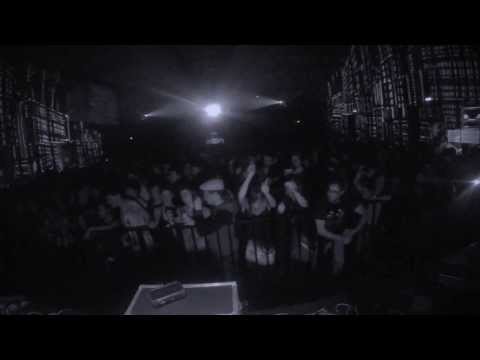
Rootystep: Meetings open up opportunities. We started with Diazzo, whose projectors can throw still images of 8 metres by 10 metres. Kazi was working with them, we tried it once, at La Carène (in Brest, ed.), for the first time with our sound system. And then there was the Télérama Dub Festival in 2013: that night, we were blown away. The idea is to plunge people into our universe, both sonic and graphic.
So what you want, in the end, is to keep control?
Rootystep: And to offer things the way we want to offer them. With the label we like the craft side of making an object, calling on a good graphic designer, going to the trouble of choosing the paper, the inner sleeve…
Macgyver: When you have to work with someone, adapt to a venue, to a time slot, you have to make choices, depending on what you know how to do. When you control everything from A to Z, the composition, the sound system, the scenography, your choices are almost automatic. Everything is coherent, you already know what you like and what you don't like, you ask yourself fewer questions.
Rootystep: And if you have a problem you can only blame yourself! (laughs)
|
|


 © 1999-2026


 RSS


