

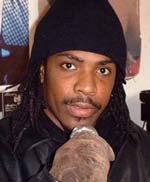
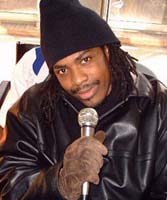
This artist's visit to Paris came as a surprise. A good surprise, because it meant discovering a very respectful and very humble singer. Some of you will have discovered him on a 45 or on his latest album «Save Me Oh Jah». With his deep, sincere voice, Paul Eliott doesn't go unnoticed among the reggaematics; maybe that's only natural, given that he started singing at 9; his style shows a certain maturity, in the voice as much as in the lyrics. His next album won't be long in coming out. In the meantime, the announcement of his new label Stronger Production should keep us waiting patiently...
Meet a fully-fledged conscious artist.
Meet a fully-fledged conscious artist.
Can you tell us about your beginnings, where were you born?
Paul Elliott I was born in Kingston 11, in the Waterhouse area. I started in the business at the age of 9, recording for lots of producers, like King Jammys, King Tubbys, Jah Life, Channel One. So I grew up in a musical environment.
As a «conscious» artist, what do you think of the conscious scene in Jamaica?
Paul Elliott Actually I think it's because of the producers who are looking to make easy money. In Jamaica it also comes a lot from most of the DJs who host the radio shows: if you only make conscious songs, you'll get fewer songs played on the radio and so fewer songs heard. If you do juggling (a more danceable riddim) you get the chance to dominate all the time, like Capleton is doing right now with cultural lyrics. Personally I try to keep up Roots & Culture lyrics, whatever the rhythm, whether it's dancehall or R'n'B.
What do you think of the «fire bun» type of message?
Paul Elliott Personally I don't set fire to anything. I don't know how they see things, but I try to wake people up with the right kind of message, even if it hurts the «vampires» who try to oppress people. I'm talking to everybody, whatever their colour or class, so I see things differently.
I systematically burn the things that oppress people. Not literally, but in the verbal sense, «faya bun».
I systematically burn the things that oppress people. Not literally, but in the verbal sense, «faya bun».
Can you tell us what your first recording was?
Paul Elliott My first record was recorded when I was 9, it was with the producer Jah Life, who was based in New York. My second recording was a maxi single in England, distributed by Music House. Other singles appeared on a compilation with Peter Metro.
You also made an album, «Save Me Oh Jah». Can you tell us more about it?
Paul Elliott That album came after a tragedy that struck me and struck my life, when they murdered my two brothers with guns in Waterhouse, and a year later they came back to kill my mother.
At one point I felt I was going to get caught up in the cycle of violence and crime, but I decided to express it in music, because I know music is a force that breaks down every obstacle without losing sight of the cause. So then came songs like «Save Me Oh Jah», «Nuff a dem a blaspheme». That's why I decided to make this album, done with different producers, but I also committed myself to taking control of my business, knowing that reggae artists always get, to use today's term, robbed by producers. The same producers who try to steal all the rights from Jamaican artists.
It's by growing up around all those producers that I learned lots of things, I saw how they operated, so that's why I decided not to get taken in by the «vampires» in reggae music [laughs].
Is that why you want to set up your own label?
Paul Elliott I already have my own label: Stronger Production, distributed by Dynamic Sound. I've recorded artists like Anthony B, Gregory Issac... I'm also doing production full time.
Have you already released these singles you're telling me about?
Paul Elliott No, they're not out yet, but soon to be released on my own label.
Is it because of the rip-offs by producers that we're seeing more and more labels owned by the singers themselves?
Paul Elliott Definitely.
Have you been a victim of these rip-offs yourself?
Paul Elliott All the time! They've always tried to exploit. But to be honest, I have good relationships with most of those producers. Because even though I know they exploit singers, in a way I still thank them, because they gave me the opportunity to use most of their labels to establish myself and make my name. So I'm not going to run them down, on the contrary I thank them, because I got a lot of information from them that taught me what I know now.
Capleton is a conscious deejay, he's number 1, everybody's talking about him. Yet slackness and gun songs are still very present. What do you think about that?
Paul Elliott Well; every man has his own mission, but I know what my mission is: spiritual and cultural, so I have to do what I have to do, without hitting out at anybody as artists, because a lot of people go through the same tribulation as me, losing someone close to gunshots, car accidents...
My aim is to share this music with those who have been oppressed.
My aim is to share this music with those who have been oppressed.
Don't you think conscious music is going to wear itself out in the end, with all these gun songs?
Paul Elliott It's all a question of promotion. If you promote slackness, you'll hear more slackness. If you promote the good, the good will win. It's up to you as an artist to take a stand. Believe in yourself, because in Jamaica they say «Self Praises is no recomendation», but I say «self praises» is the first recommendation. [Self Praises: believing in yourself]. You have to believe in yourself. If you don't believe in yourself, nobody will believe in you.
What are your plans for the future?
Paul Elliott I'm on a mission here in Paris with my official manager, Snipper, to find a distributor for my next album: The Meaning Of Life. Since Jah saved me from all those tragedies, I've found the meaning of life.
I'd like to take my music in various directions, for example if you're heartbroken, you can comfort yourself by listening to a song from this album. I've also done a few songs on dancehall riddims with a positive message, addressed to people who don't have the money to pay for their children's education, because now in Jamaica you need a lot of money to send a child to school and poor families can't cope. So I put that into music to let people know what we're going through. We are the victims of all our leaders' mistakes. And that's the message I want to bring on a reggae record, because reggae has a healing power, it lifts people's spirits.
I'd like to take my music in various directions, for example if you're heartbroken, you can comfort yourself by listening to a song from this album. I've also done a few songs on dancehall riddims with a positive message, addressed to people who don't have the money to pay for their children's education, because now in Jamaica you need a lot of money to send a child to school and poor families can't cope. So I put that into music to let people know what we're going through. We are the victims of all our leaders' mistakes. And that's the message I want to bring on a reggae record, because reggae has a healing power, it lifts people's spirits.
Do you think singing conscious lyrics on dancehall riddims helps broaden your audience or get your message across better?
Paul Elliott About that, let me tell you something: these days a lot of kids listen to dancehall riddims the way they listen to hip hop, and to reach that audience you have to ride dancehall riddims, as long as you keep the message positive.
What do you think of the internet, since a lot of rastas speak badly of it?
Paul Elliott The internet is the future, so you have to get ready for the future, because that's where the world is going right now, so you have to take part, you mustn't run away from it.
"New Time, New Technology" But always keep the pen and paper, which are the roots, and don't become dependent on computers.
"New Time, New Technology" But always keep the pen and paper, which are the roots, and don't become dependent on computers.